.png)
.png?mask=1)
With a flick of a light switch and a whir of a fan, darkness descends on a second story classroom inside Steel Valley High School. A dozen or so students sit in high-back chairs, waiting for their eyes to adjust to the near pitch-black environment. After just a few minutes, the night sky opens up above them, and astronomy teacher Mr. Jeffrey Deabner begins to explain the relationship between constellations and world cultures.
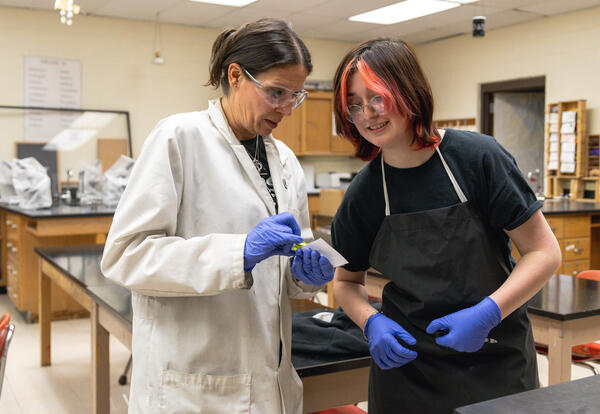
Down the hall, a quartet of students inside Ms. Erika Podnar’s classroom slip on gloves and aprons. Within minutes, they’re dusting a table in the lab for their own fingerprints, as Ms. Podnar – a former crime scene investigator – explains the real-world challenges forensics teams run into on crime scenes around the world.
The classes are just two examples of Steel Valley’s emphasis of hands-on learning in its high school science curriculum. As Pennsylvania schools formally adopt the new STEELS science curriculum standards, which prioritize active investigation and practical application of the scientific method instead of rote memorization of facts, Steel Valley’s science teachers are demonstrating that seeing is believing, and doing is understanding.


“The applications that we are doing in class definitely de-emphasize the memorization that took place during my own years of education,” said Ms. Meagan Tracy, biology teacher and head of the science department, “but I see the students are learning and processing those facts in new and exciting ways, which is much more engaging. It also naturally encourages the students to generate new questions to explore as they gain confidence.”
Science classes have always had a laboratory component at the high school level, whether it was mixing solutions in a beaker, dissecting a frog, or testing the laws of physics. But science also can present challenges for students with the complex terminology and advanced mathematics needed in some classes. It often leads to the age-old question, “When will we ever use this?”
Biology teacher Ms. Chloe Pierce said bringing projects and labs into the classroom that have real-world applications or meaningful consequences helps answer that question and engage the students.
“They want to understand how what we learn in biology class connects to their own lives and the world around them,” Ms. Pierce said. “For example, in our current mutation project, students research how a single change in the genetic code can lead to significant effects on an organism. Projects like this resonate with them because they can see the direct impact of biological concepts beyond the classroom.”

The science department’s use of hands-on learning goes beyond labs and experiments. It can even be found in lessons about moles, a unit of measurement that represents the very large number of molecules, atoms, or other tiny, miniscule elements in a substance like gold, calcium, or oxygen. To help wrap their students’ heads around the concept, chemistry teachers Ms. Erika Podnar and Ms. Madhura Ranade have them create actual moles – stuffed animal versions of the rodents that end up representing each element.
Ms. Podnar built a large, free-standing periodic table with slots for each element. The students take their newly stuffed and stitched mole, research the element they’ve been assigned, and fill out a card with the appropriate information about the element. They become experts on the element, and in the process it helps them visualize material they would otherwise have to memorize or learn another way.


For chemistry students like senior Amber Fey, that visual element plays a crucial role.
“For me, that's actually the easier way to learn, because I like to visualize things, and Ms. Podnar is really helpful, especially with the mole project,” Fey said, adding that her focus in other classes is on reading and trying to commit information to memory that way.
The visualization helps across scientific disciplines, whether it’s in biology, chemistry, astronomy, physics, or forensics science. In the first three months of the year, Steel Valley High School students have built water towers, experimented on the effectiveness of hand sanitizer versus soap, utilized chemical tests as part of a pretend murder investigation, used light microscopes to study cell replication, extracted DNA from strawberries, analyzed climatographs of coordinates on Google Maps to explore biomes and explain how different abiotic factors affect populations and biodiversity, and more.
"My favorite science activity we’ve done so far was the water tower challenge because even though we were having fun, we were also learning,” ninth grader Olivia Petras said. “It was really fun to communicate with my team to form a plan and have to get it done in a certain period of time with a maximum cost because it taught us teamwork. I also enjoyed winning the competition too."

“Students are constantly asking when our next lab will be and they genuinely look forward to those days. Hands-on activities give them the chance to apply their knowledge in a tangible way, and I notice a clear boost in their energy and attentiveness during labs,” Ms. Pierce said. “They also appreciate the variety in our class structure – alternating between text-based work, projects, and labs keeps the learning experience fresh and engaging. This mix maintains their interest and supports their understanding of biological concepts.”
Many of the projects are conducted in small groups, which require the students to further develop their soft skills like problem solving and communication. Ninth grader Micah Thomas said he likes those small groups in biology class, “because it gives me room to cooperate and chat and work together with people I don’t talk to on the regular."
Collaboration isn’t just for the students. Nearly two decades ago, Ms. Yvette Logan – now the Dean of Students for the High School – began working with seventh grade teacher Ms. Tracy McGrew to have high school kids in chemistry classes mentor the younger students and help foster their love of the sciences. Ms. Ranade is now continuing that annual tradition with her students, and this year the high school students helped the middle school students complete flame tests for group 1 and group 2 ions.


Ms. Tracy said the department plans to collaborate and host a STEM Career Fair again this year, which will connect students with Steel Valley alumni in STEM fields. Retired department head, Mrs. Michelle Maddigan, herself a Steel Valley graduate, saw value in Steel Valley graduates inspiring future graduates. She began the Career Fair before her retirement. The department is also working closely with Assistant Superintendent Dr. Brian Plichta to adopt the STEELS standards, providing professional development and exploring new ways to further engage with students.
In the meantime, the students’ curiosity is growing and their knowledge is expanding as they investigate and explore.
“I have really enjoyed seeing my students work together to problem solve on a few projects so far this year,” Ms. Tracy said. “The teamwork that I witnessed was indicative of what employers are asking for of our graduates.”


