.png)
.png?mask=1)
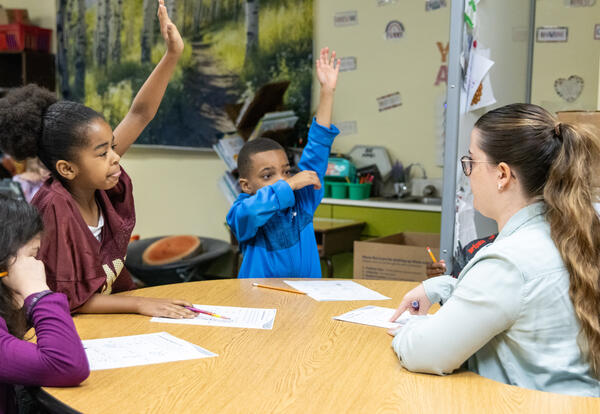
If a visitor were to step inside Rylee Varhola’s classroom on the top floor of Barrett Elementary on any given morning and observe her fourth-graders as they work on their math problems, they would be hard-pressed to easily identify which students were gifted, which students were English Language Learners, and which ones were special education students with Individualized Education Plans (IEPs). Every student gets involved in the lesson, and every student gets what they need to succeed.
That’s the goal of Barrett’s inclusive model for English Language Arts (ELA) and Mathematics, an approach that is now in its second year. Instead of pulling out special education students for individualized or small-group instruction, the special education staff joins the classroom teacher for individualized instruction, small group instruction, and full class instruction.
“If it's done right, it's not something you should see,” said learning support specialist Brynn Ebbitt, who has taught at Barrett for over a decade. “It should be almost invisible, that these teachers are just teachers, these students are just students. It's not necessarily these ones that are pulled because they're different, or they have a challenge.”

The inclusive model began with a trial run for ELA last year. It expanded to include math this year following extensive training and professional development.
“It's important that this isn't just putting special ed kids in a classroom,” Barrett Principal Kim Winters said. “It's really, truly about trying to provide what we can for each student in a classroom where everybody feels welcomed and supported.”
When special education students aren’t included in instruction with their peers outside of specials like art and music, a gap can form. The inclusive model works to eliminate that divide.
“It also teaches the students empathy and respect for kids that maybe don't know something that they know,” Mrs. Winters said. “They can kind of be the teacher or the role for that person.”

The inclusive model relies on differentiated instruction, which means adapting the material to meet the needs of the students. It’s something regular education teachers were already doing, and Mrs. Winters said that was a key component to helping the staff adapt.
“My teachers have really put their insecurities aside as to what this is and they have truly realized that this is something they’ve done all along,” she said. “Maybe they just never had a name to put with it. Teachers do this every day in their classrooms. They differentiate. They create things for their low-level learners. They create activities that will challenge their high-level learners.”
Ms. Varhola said the key is planning and communication. During a recent inclusion period, she was joined by Ms. Ebbitt, math specialist/Title I coach Kevin Tomasic, and paraprofessional Christine Nagle. Ms. Varhola will often sketch out a lesson plan, then solicit feedback from the team to ensure they’re meeting student needs and on the same wavelength. But it took some refinement early on.
“With our paired teaching, at the beginning of the year I was putting it all on myself,” she said. “It was like, “I’m the teacher. I need to do this. We need to get it all done.”
That changed when the math coach from the AIU visited for an observation period.
“She opened it up to some suggestions to how we can implement the paired teaching a little better,” she said. “Since then, it has helped for myself to take a step back and have Ms. Ebbitt do part of the lesson, to break it up so it’s not just me. They’re seeing the lesson in a different way, as well.”

The structure of the inclusion period looks different for each grade level. In Amy Selick’s second grade classroom, she’s joined each morning by learning support specialist Maeve Metzgar. Students rotate between four groups – one with Ms. Selick, one with Ms. Metzgar, one focused on independent work, and one focused on technology. Each rotation lasts about 15-to-20 minutes. There is also time for full classroom instruction.
“They're getting what they need at each rotation, but then they're also getting the second-grade curriculum at the same time,” Ms. Selick explained.
The groups are created based on ability, not on whether students have IEPs or are English Language Learners.
“That’s what's nice about the groups, because even if they're doing the same stuff, I can have the kids who are more independent do their work more independently, and then the kids that need support, I can guide that reading more and help them,” Ms. Metzgar said.

Much like in fourth grade, the focus is flexibility and adaptability, to adjust to meet the needs of students as they arise and to do it all in the classroom rather than in a separate area.
“Every kid has different needs, and as a group, we’re coming together, figuring that out, and we’re making things happen in this room,” Ms. Selick said. “We’re seeing emotional growth, academic growth, behavioral growth. Is every day perfect? No, but from where they were at the start of the year to where they are now, it’s a big change.”
The staff have seen students voluntarily help each other, too. That peer support is one of other reasons Mrs. Winters wanted to implement the inclusive model.
“I think a big key piece is letting children learn from each other, creating that environment of respect and rapport, teaching children to be empathetic, explaining to children that not all children learn the same, and that's okay, but every child has the right to learn,” Mrs. Winters said.
Mrs. Winters and the Barrett staff will have two years’ worth of ELA data to evaluate the model’s effectiveness. They’ll continue to monitor academic performance, behavior, and attendance. It will take time to make a true evaluation, but for now, the early indicators are positive. In fourth grade, for example, approximately 80 percent of students have progressed in a positive direction.
“I don’t know if it's just our students this year or if it’s the inclusion model, but I have seen a difference. All of the students have either met or surpassed their goal from the beginning of the year,” Ms. Varhola said. “I feel like we've done what we've needed to do in past years, but the inclusion model has really helped to enhance those struggle areas.”
“You want to see growth in academics for students with disabilities. You want to see improved attendance, behavior, student engagement, and then positive feedback from the families and staff,” Mrs. Winters said.
It’s even been beneficial for teachers. While it requires an extensive amount of planning, special education teachers like Ms. Metzgar and Ms. Ebbitt feel like they’re on the same page with the classroom teachers more often than they were in the past. Ms. Ebbitt said it’s made her a better teacher.
“For the longest time, I was just an island, and everything was just the way that I had always done things,” she said. “Being able to push into other teachers’ classes and see different styles, different activities - it's the same content, but presented differently, and I can take a little bit of that with me.”

As Barrett Elementary and Park Elementary prepare to merge into the new Steel Valley Elementary next fall, Mrs. Winters and the staff are sorting out how to implement the inclusive model with all Pre-K through fifth grade students in one building.
“I take a lot of pride in the fact that I was chosen to be the leader of the new building. I have an excellent assistant principal in Cara McKenna,” Mrs. Winters said. “We have to be creative in finding ways to still support the inclusive model, but also to make sure that our support systems can get to those students that are included.”
“It's exciting,” she added. “It's a lot of work, but it's something that I think, in the end, is going to be just something really awesome for Steel Valley.”

